Diwali 2026: Lakshmi Puja on Sunday 8 November
October 17, 2026
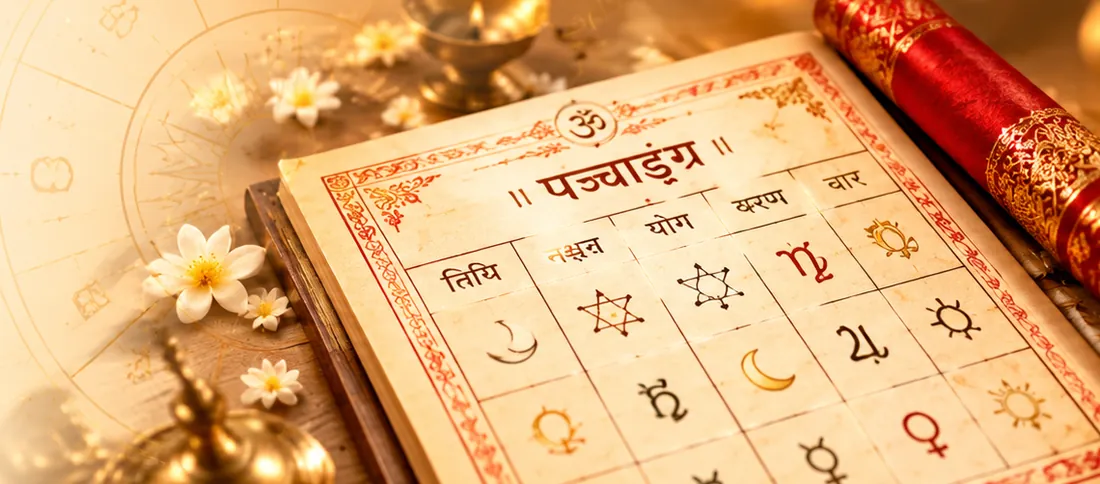
Diwali's main night, Lakshmi Puja, falls on Sunday 8 November 2026. The date is not fixed by the solar calendar: it is set by the Moon, on the Amavasya (new moon tithi) of the month of Kartika, and by the hour at which that tithi holds. This article shows how the day is chosen, gives the evening's timings for New Delhi as the site's panchang works them out, and adds a short note for each Moon sign.
How the day is chosen
A tithi is a twelfth part of the Moon's monthly journey away from the Sun: one tithi for every 12° the Moon gains. Tithis do not line up with civil days, so a festival tied to a tithi needs a rule for which day to keep. For Lakshmi Puja the rule followed by north Indian almanacs is that the Amavasya should hold during Pradosh, the first part of the night after sunset.
In 2026 the Amavasya begins at 11:28 IST on 8 November and ends at 12:32 IST on 9 November. On the evening of the 8th the Sun sets at 17:31 IST and the Amavasya runs through the whole of Pradosh. By sunset on the 9th it has already ended. So Lakshmi Puja is on the 8th. Drik Panchang gives the same day, with the Amavasya from 11:27 AM to 12:31 PM; it truncates to the minute as almanacs do, which accounts for the difference of a minute.
The month has two names, depending on the calendar you follow. In the amanta reckoning used in much of the south and west, where a month ends at the new moon, this is the Amavasya of Ashvina. In the purnimanta reckoning of the north, where the dark fortnight belongs to the month that follows, it is Kartika Amavasya. It is the same night either way; the site's panchang shows both names.
Lakshmi Puja timings for New Delhi
- Amavasya: 11:28 IST, 8 November to 12:32 IST, 9 November.
- Sunset: 17:31 IST.
- Pradosh: 17:31 to 20:09 IST. The site reckons Pradosh as the first fifth of the night, from sunset to the next sunrise.
- Vrishabha (Taurus) rising: 17:54 to 19:50 IST.
Many families perform the puja while a fixed sign is rising within Pradosh, and Taurus is the fixed sign that rises in the early evening at this time of year. The overlap of the two, 17:54 to 19:50 IST, is the window Drik Panchang also prints for New Delhi. Sunset and the rising signs change with your place, so check them for your own city on the panchang page.
The five days
Each day of Diwali has its own tithi and its own rule, and each was worked out the same way:
- Dhanteras — Friday 6 November. The Krishna Trayodashi, which runs from 10:31 IST on the 6th to 10:48 IST on the 7th, holds through that evening's Pradosh. It is traditionally a day to buy metal utensils or jewellery and to light a lamp for Yama at the door.
- Naraka Chaturdashi — Sunday 8 November, at dawn. The Chaturdashi is the tithi at sunrise on the 8th and ends at 11:28 IST, so this year the early bath of Naraka Chaturdashi and the evening's Lakshmi Puja fall on the same day.
- Lakshmi Puja — Sunday 8 November, evening. As above.
- Govardhan Puja — Tuesday 10 November. The Shukla Pratipada is the tithi at sunrise. Annakut, the offering of many dishes, is made that day.
- Bhai Dooj — Wednesday 11 November. The Shukla Dwitiya runs from 14:00 IST on the 10th to 15:53 IST on the 11th, and so covers the whole afternoon of the 11th, the part of the day the rule asks for.
The sky that night
At Lakshmi Puja the Sun and the Moon are together in Libra, as they are at every new moon of this month. The Moon is in Swati nakshatra and the Sun in Vishakha. In the site's table of dignities the Sun is in its fall in Libra. Jupiter has just entered Leo (on 31 October), and Saturn is retrograde in Pisces. None of this changes the festival; it is simply what the sky holds while the lamps are lit.
Your Moon sign
Count from the sign the Moon was in at your birth, your own sign being the 1st; a free birth chart tells you which it is. Two things are noted for each sign. The Sun's house is the house of the solar month the festival falls in (the Sun is in Libra from 17 October to 16 November); the classical gochara table counts the 3rd, 6th, 10th and 11th as good for it. The Moon's house is for the evening of the puja: Chandrabala, the Moon's support, holds when the Moon is in the 1st, 3rd, 6th, 7th, 10th or 11th from your Moon sign, the list Drik Panchang prints as "Good Chandrabalam". Where it does not, nothing is forbidden; the festival is for everyone.
Aries Moon (Mesha). The Sun is in your 7th house this month, not one of the Sun's favourable houses; on the evening of the puja the Moon is in your 7th, so Chandrabala holds. Partnerships and family gatherings are where the evening's warmth is found.
Taurus Moon (Vrishabha). The Sun is in your 6th house, a favourable house for the Sun, and the Moon is in your 6th that evening, so Chandrabala holds. Work and health habits benefit from the season's order.
Gemini Moon (Mithuna). The Sun is in your 5th house, not one of the Sun's favourable houses; the Moon is in your 5th, and Chandrabala does not hold. A quiet, devotional puja with children or students suits the night.
Cancer Moon (Karka). The Sun is in your 4th house, not one of the Sun's favourable houses; the Moon is in your 4th, and Chandrabala does not hold. The home itself is the focus: cleaning, lamps and family.
Leo Moon (Simha). The Sun is in your 3rd house, a favourable house for the Sun, and the Moon is in your 3rd, so Chandrabala holds. Effort and initiative are well supported this month.
Virgo Moon (Kanya). The Sun is in your 2nd house, not one of the Sun's favourable houses; the Moon is in your 2nd, and Chandrabala does not hold. Keep spending on the festival within your means.
Libra Moon (Tula). The Sun is in your 1st house, not one of the Sun's favourable houses; the Moon is in your 1st, so Chandrabala holds. Rest well amid the celebrations; the Sun over your own sign asks for care of health.
Scorpio Moon (Vrishchika). The Sun is in your 12th house, not one of the Sun's favourable houses; the Moon is in your 12th, and Chandrabala does not hold. A reflective festival: charity and giving suit it.
Sagittarius Moon (Dhanu). The Sun is in your 11th house, a favourable house for the Sun, and the Moon is in your 11th, so Chandrabala holds. Friends and wider family bring the season's gains.
Capricorn Moon (Makara). The Sun is in your 10th house, a favourable house for the Sun, and the Moon is in your 10th, so Chandrabala holds. Work and standing are supported; the puja at a place of business is traditional.
Aquarius Moon (Kumbha). The Sun is in your 9th house, not one of the Sun's favourable houses; the Moon is in your 9th, and Chandrabala does not hold. Honour elders and teachers during the festival.
Pisces Moon (Meena). The Sun is in your 8th house, not one of the Sun's favourable houses; the Moon is in your 8th, and Chandrabala does not hold. Keep the night simple and avoid risky purchases.
Observances
Lakshmi is the deity of Venus in the tradition's correspondences, and Friday is Venus's day; on Diwali itself she is worshipped with lamps, white flowers and sweets after the house has been cleaned. The puja items the site's reference lists for Lakshmi are white flowers, sugar, curd and white cloth. Ganesha is worshipped first, as at the start of any puja. Lighting lamps at the door and windows, sharing sweets and giving to those in need are the parts of the festival everyone can keep.
Use the tools
- The day's tithi, nakshatra, sunset and Choghadiya for your city: panchang.
- Background on tithi and the rest of the five limbs: the Panchang Guide.
- Your horoscope for November, or a good day for a purchase with the muhurta finder.
General guidance for a Moon sign, not a personal reading. Timings are for New Delhi; check your own city on the panchang page.